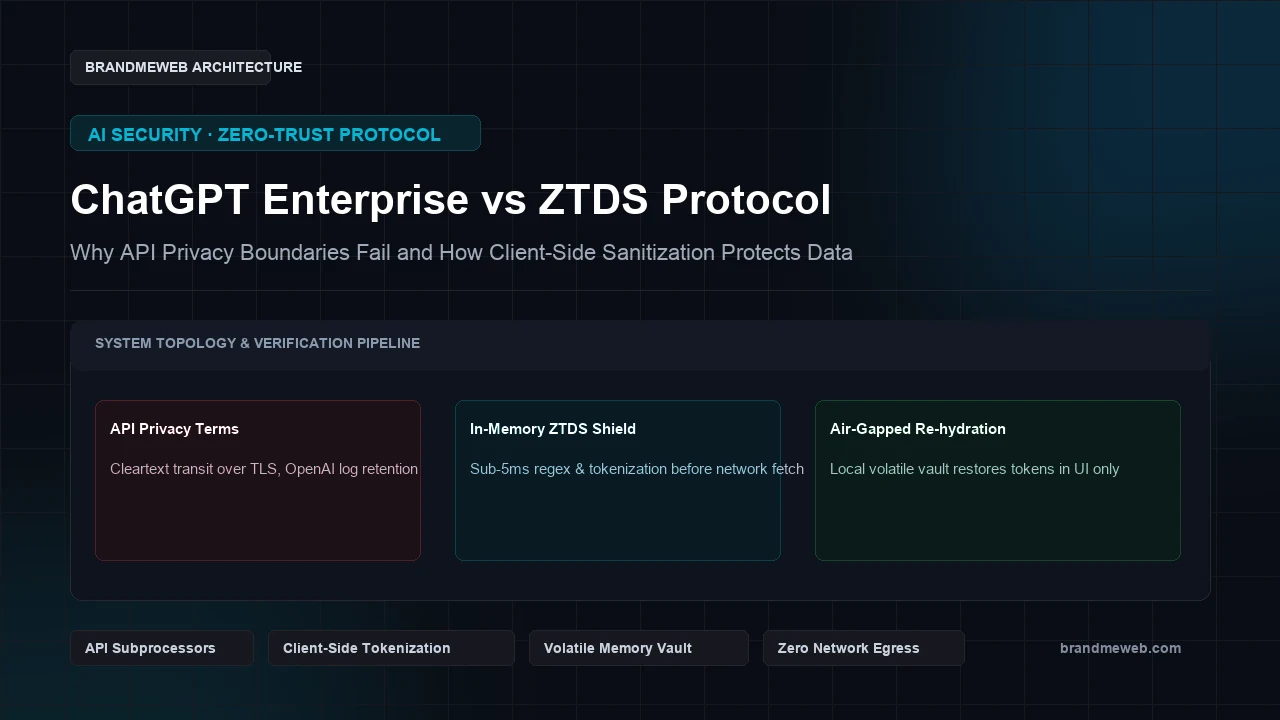
The Optical Illusion of Enterprise Privacy in Commercial AI APIs#
Over the past two years, enterprise sales teams at major AI vendors have successfully promoted a comforting narrative to corporate leadership: *"Upgrade to our Enterprise tier, and your data is 100% private and protected."*
C-level executives, CISOs, and legal counsels routinely sign seven-figure enterprise agreements under the assumption that selecting an option labeled "Enterprise" or checking "Do not train on customer inputs" eliminates corporate security and regulatory exposure.
In practice, this belief represents an optical illusion that confuses commercial contractual promises with deterministic cryptographic guarantees.
Examining the actual technical mechanics of standard commercial AI APIs reveals three critical vulnerabilities: 1. Cleartext Network Transit: Prompts containing customer identities, medical records, financial balances, and source code are transmitted in cleartext over TLS to external cloud servers. 2. Provider-Side Decryption & Ingestion: The vendor perimeter decrypts the payload into GPU host memory to generate model responses. 3. Mandatory 30-Day Abuse Logging: Unless an enterprise completes a rigorous, custom zero-data-retention (ZDR) review, standard API endpoints retain unencrypted prompt transcripts for up to 30 days in accessible monitoring logs for abuse detection.
> A contractual promise stating *"We do not use your data for training"* is not security. It is merely a paper promise. If an attacker breaches the vendor cloud infrastructure or a rogue employee inspects telemetry logs, your raw customer data is completely exposed.
The Subprocessor Dilemma under GDPR and Global Privacy Statutes#
From a regulatory standpoint, sending cleartext personal data to an AI API creates immediate compliance liabilities under GDPR Article 28, HIPAA, CCPA, and Israel Amendment 13.
The moment cleartext PII enters an external AI service: - The AI vendor legally becomes a data subprocessor. - You must negotiate, maintain, and audit complex Data Processing Agreements (DPAs). - In the event of a security incident at the vendor level, your company carries joint statutory liability and notification obligations to affected users. - International data transfers to US-hosted infrastructure trigger cross-border transfer restrictions and mandatory transfer impact assessments (TIA).
┌────────────────────────────────────────────────────────────────────────┐
│                 COMMERCIAL AI API VS ZTDS ARCHITECTURE                 │
├──────────────────────────┬─────────────────────────────────────────────┤
│ Dimension                │ Commercial AI API (Standard Enterprise)     │ ZTDS Open Standard Protocol               │
├──────────────────────────┼─────────────────────────────────────────────┤
│ Network Transmission     │ Cleartext PII transmitted over network      │ Zero cleartext PII crosses network perimeter│
│ Subprocessor Liability   │ Vendor is legal subprocessor (DPA required) │ Vendor receives zero PII (Zero-DPA memo)  │
│ Abuse Log Exposure       │ Raw prompts stored in 30-day cloud logs     │ Only masked tokens appear in provider logs│
│ Tokenization Boundary    │ Server-side or unmasked                     │ Local client RAM (sub-5ms WASM execution) │
│ Regulatory Attack Vector │ Vendor breach exposes entire customer base  │ Mathematically impossible cloud breach    │
└──────────────────────────┴─────────────────────────────────────────────┘
How ZTDS Enforces Zero Network Egress at the Device Level#
The Zero-Trust Data Sanitization (ZTDS) architecture flips the security model entirely. Instead of relying on vendor promises to treat sensitive data respectfully after receiving it, ZTDS guarantees that the vendor *never receives cleartext sensitive data in the first place*.
The technical pipeline executes locally on the client device in sub-5ms:
- 1Local Pattern & Entity Detection:
- 2Before an HTTP request or WebSocket message is dispatched to an AI model, the raw prompt string is intercepted by an in-memory sanitizer running in browser JavaScript or local WebAssembly. High-performance regex engines scan for Israeli IDs, email addresses, phone numbers, credit card sequences, JWTs, and API credentials.
- 1Deterministic Token Substitution:
- 2Identified entities are replaced with deterministic contextual placeholders:
Raw Input:
"Please analyze customer 038472918 (dan.cohen@techcorp.co.il) who owes 45,000 ILS on invoice #9482."

Sanitized Payload Dispatched to LLM:
"Please analyze customer [ISRAEL_ID_TOKEN_1] ([EMAIL_TOKEN_1]) who owes [CURRENCY_TOKEN_1] on invoice [INVOICE_TOKEN_1]."
- 1Volatile Memory Vault Isolation:
- 2The mapping table linking
[ISRAEL_ID_TOKEN_1] -> 038472918is retained strictly within the local client's volatile RAM. It is never transmitted across the network, never written to persistent disk storage, and never logged to cloud databases.
- 1Local Re-hydration:
- 2When the LLM streams its response back to the client UI, the local runtime intercepts the incoming tokens and substitutes the original values back into the visual display seamlessly for the authorized user.
> Because the external AI vendor receives strictly context-preserving pseudonymous tokens with zero access to the private mapping vault, the payload does not constitute "personal data" under GDPR Recital 26 and Israel Amendment 13. Subprocessor chains are completely eliminated.
Implementing Zero-Trust AI Workflows in 3 Steps#
- 1Verify Your Current Prompt Exposure:
- 2Use the BrandMeWeb AI Data Leak Checker to test how your typical CRM, legal, or developer prompts look when sanitized under the ZTDS standard.
- 1Deploy Local In-Memory Gateways:
- 2Replace direct API calls in your frontend applications and internal tools with local client sanitization pipelines.
- 1Schedule an Enterprise Compliance Audit:
- 2Engage the BrandMeWeb engineering team for an AI Compliance & Privacy Audit to certify your infrastructure and secure an official Zero-DPA compliance memorandum.