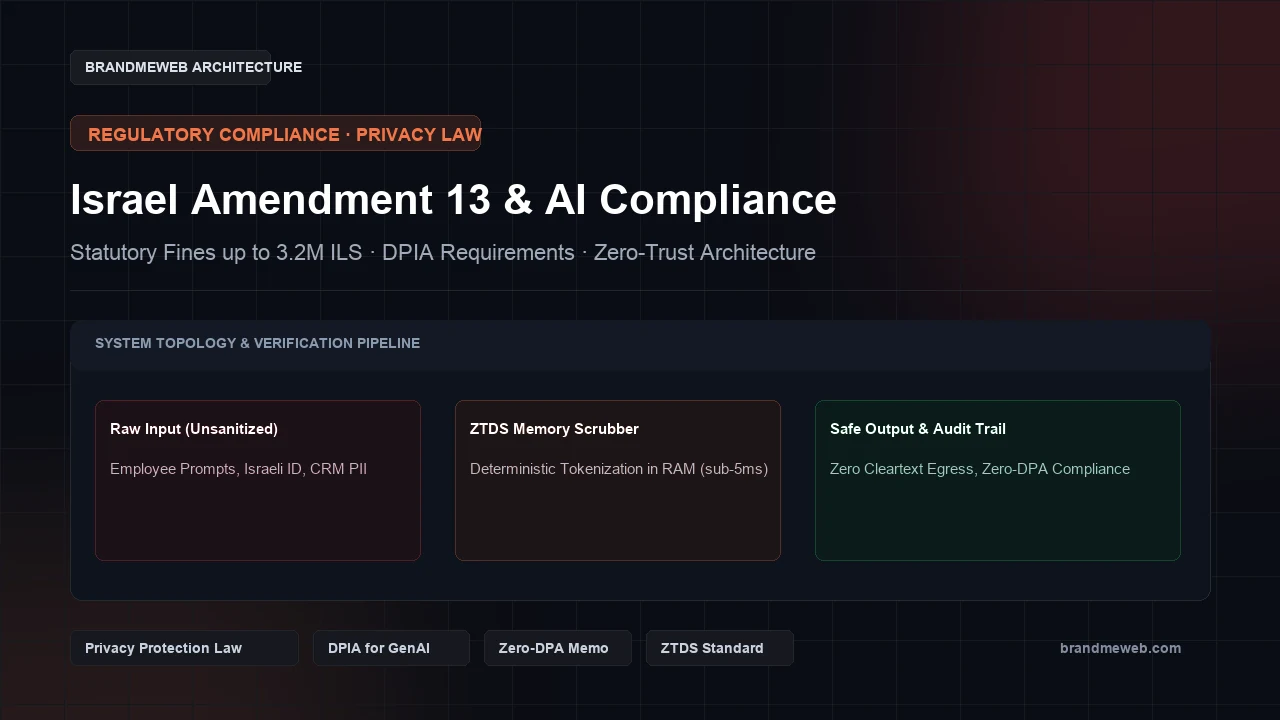
The Regulatory Storm: What Israeli Tech Companies Must Know About Amendment 13#
The Israeli privacy landscape underwent its most radical transformation in over four decades with the passage of Amendment 13 to the Privacy Protection Law (5741-1981). Enacted by the Knesset with phased enforcement taking full statutory effect through 2025 and 2026, Amendment 13 fundamentally shifts Israel from an outdated, notice-only framework to an aggressive, enforcement-driven regime closely modeled after European GDPR standards.
For technology companies, software startups, and digital agencies operating in Israel or handling Israeli citizen data, the era of treating privacy as an afterthought is definitively over.
Key statutory changes under Amendment 13 include: - Massive Administrative Penalties: The Privacy Protection Authority (PPA) can now impose administrative fines exceeding 3.2 million ILS for corporate data violations, alongside personal liability and sanctions for corporate officers and directors. - Statutory Damages Without Proof of Injury: Individuals whose personal data has been handled in violation of statutory duties can claim statutory compensation up to 10,000 ILS per violation without needing to prove actual financial damage. - Mandatory Data Protection Officers (DPO): Organizations holding sensitive biometric, financial, medical, or tracking data above statutory thresholds must appoint a certified DPO reporting directly to senior management. - Compulsory Privacy Impact Assessments (DPIA): Deploying novel algorithmic processing or automated artificial intelligence systems requires formal, documented DPIA evaluations prior to production rollout.
> Under Amendment 13, corporate directors and chief executives cannot hide behind corporate shields. If an enterprise fails to implement technical safeguards or permits uncontrolled data leaks, regulators can initiate direct enforcement actions against officers personally.
The GenAI Exposure Gap: How Employees and Shadow AI Create Massive Liability#
While security teams concentrate on firewalls and network perimeters, the single largest vulnerability in Israeli tech companies today is Shadow AI—the uncontrolled transmission of sensitive corporate and customer data into external large language models (LLMs).
Across software development, customer support, legal drafting, and HR workflows, employees routinely copy and paste: 1. Israeli National Identification Numbers (Teudat Zehut): Included in customer support tickets and user verification queues. 2. Customer CRM Data & Payment Logs: Pasted into ChatGPT to summarize customer sentiment or generate account status drafts. 3. Internal Source Code & API Keys: Loaded into AI web interfaces or IDE chat assistants to debug complex services. 4. Employee Personnel Records & Salary Calculations: Processed through external models to draft performance appraisals.
┌────────────────────────────────────────────────────────────────────────┐
│               THE SHADOW AI LIABILITY CASCADE UNDER AMENDMENT 13       │
├──────────────────┬──────────────────┬─────────────────┬────────────────┤
│ Employee Prompt: │ Cloud Provider:  │ Legal Status:   │ Regulatory     │
│ Pastes customer  │ Ingests cleartext│ OpenAI becomes  │ Consequence:   │
│ ID and CRM notes │ payload over     │ unauthorized    │ Direct fine up │
│ into ChatGPT web │ network API      │ subprocessor    │ to 3.2M ILS!   │
└──────────────────┴──────────────────┴─────────────────┴────────────────┘
The moment cleartext personal data crosses the network perimeter into an external AI cloud, your organization has executed an unauthorized international data transfer and initiated a third-party subprocessor chain under GDPR Article 28 and Amendment 13.
> Even if you sign a commercial data processing agreement (DPA) with an AI vendor, you remain fully liable for vendor breaches and regulatory non-compliance. The only mathematically airtight defense is Zero External Egress Prior to Sanitization—ensuring cleartext PII never leaves local volatile memory.
The 4 Invariants of ZTDS (Zero-Trust Data Sanitization)#
To bridge the gap between AI productivity and strict regulatory compliance, BrandMeWeb applies the Zero-Trust Data Sanitization (ZTDS) standard. Governed by four strict mathematical and architectural invariants, ZTDS physically prevents data leakage before network packets are dispatched:
- 1Invariant 1: Zero External Egress Prior to Sanitization:
- 2All prompt strings, documents, and API payloads undergo deterministic tokenization locally in device RAM. No cleartext personal identifier, national ID, phone number, or credential ever leaves the client machine unmasked.
- 1Invariant 2: Deterministic Reversible Tokenization:
- 2Sensitive entities are mapped to contextual token identifiers (such as
[ISRAEL_ID_TOKEN_1]or[EMAIL_TOKEN_2]). The LLM processes tokenized context naturally, while the reversible translation table remains strictly in the client volatile memory vault.
- 1Invariant 3: Verifiable Cryptographic Isolation:
- 2Sanitization logic executes within client-side WebAssembly (WASM) or an air-gapped local runtime with zero third-party telemetry, zero external tracking pixels, and zero cloud logging.
- 1Invariant 4: Continuous Compliance & Zero Subprocessor Chain:
- 2Because no cleartext personal data crosses the provider boundary, the external AI vendor never receives personal data under statutory definitions. This completely eliminates subprocessor liability under GDPR Article 28 and Amendment 13, rendering complex multi-party DPAs obsolete.
The 30-Minute Turn-Key Compliance Playbook#
Achieving verifiable Amendment 13 compliance does not require months of abstract legal consulting. Follow this 4-step engineering playbook:
- 1Audit Live Prompts Locally:
- 2Open the free, in-browser BrandMeWeb AI Data Leak Checker. Paste representative enterprise prompts or test customer payloads. The scanner runs 100% in local browser memory and diagnoses PII risks in sub-5ms with zero network transmission.
- 1Conduct an Enterprise Snapshot Audit:
- 2Commission the BrandMeWeb AI Compliance & Privacy Audit. For a flat $2,500 setup, our team conducts a 30-minute turn-key architectural audit, maps all Shadow AI endpoints, and issues an executive-ready Zero-DPA compliance memorandum.
- 1Deploy Client-Side Tokenization:
- 2Integrate in-memory sanitization across internal developer tools, customer portals, and CRM integrations using our air-gapped client libraries.
- 1Establish Ongoing Telemetry:
- 2Lock in continuous compliance monitoring for $500/month, ensuring quarterly DPIA updates, new vector protections, and continuous regulatory shield maintenance.
Frequently Asked Questions (FAQ)#
When does Amendment 13 to the Privacy Protection Law take effect? Amendment 13 was formally enacted by the Israeli Knesset in August 2024, with primary enforcement provisions taking effect in August 2025 and full statutory penalty mechanisms ramping up through 2026. Tech enterprises must achieve full architectural compliance immediately to eliminate legacy liability.
Can an enterprise rely on ChatGPT Team or Enterprise privacy terms for compliance? No. While ChatGPT Enterprise terms stipulate that OpenAI does not train models on API inputs, cleartext prompts are still transmitted across external networks, processed on US servers, and retained in 30-day abuse monitoring logs. This constitutes an international data transfer and engages third-party subprocessor requirements under Amendment 13.
What is a Zero-DPA compliance memorandum? A Zero-DPA compliance memorandum is an authoritative legal and technical certification issued following a ZTDS architectural audit. It documents that because all personal identifiers are sanitized client-side in volatile memory before cloud egress, no personal data is transferred to external LLM providers, legally obviating the requirement for complex multi-tier Data Processing Agreements.
Amendment 13 & Enterprise AI Compliance Diagnostic
Check active controls to calculate regulatory liability and generate actionable technical recommendations.
Direct exposure to 5% global turnover sanctions
Zero in-memory data egress controls in place. Unsanitized prompts create statutory liability.