The Zero-Click Search Reality: Why Traditional Rank Tracking Is Obsolete#
Search behavior has undergone its most radical transformation since the inception of Google. Across high-intent commercial and B2B queries, search engines no longer simply rank 10 blue links; they synthesize answers directly inside Google AI Overviews (SGE) and conversational search engines like ChatGPT Search and Perplexity AI.
When a decision-maker searches for *'best enterprise data sanitization tool'* or *'Next.js technical SEO consultant in Israel'*, the AI model generates a comprehensive comparative summary at the very top of the screen. Users read the synthesized recommendation, inspect the cited source cards, and convert—without ever scrolling down to organic position #1.
> Holding organic rank #1 on Google used to guarantee a 32% click-through rate. In 2026, if an AI Overview appears above your organic listing and cites your competitor instead of your brand, your effective CTR plummets by up to 65%. You cannot manage what you do not measure.
How the BrandMeWeb AI Citation Radar Works#
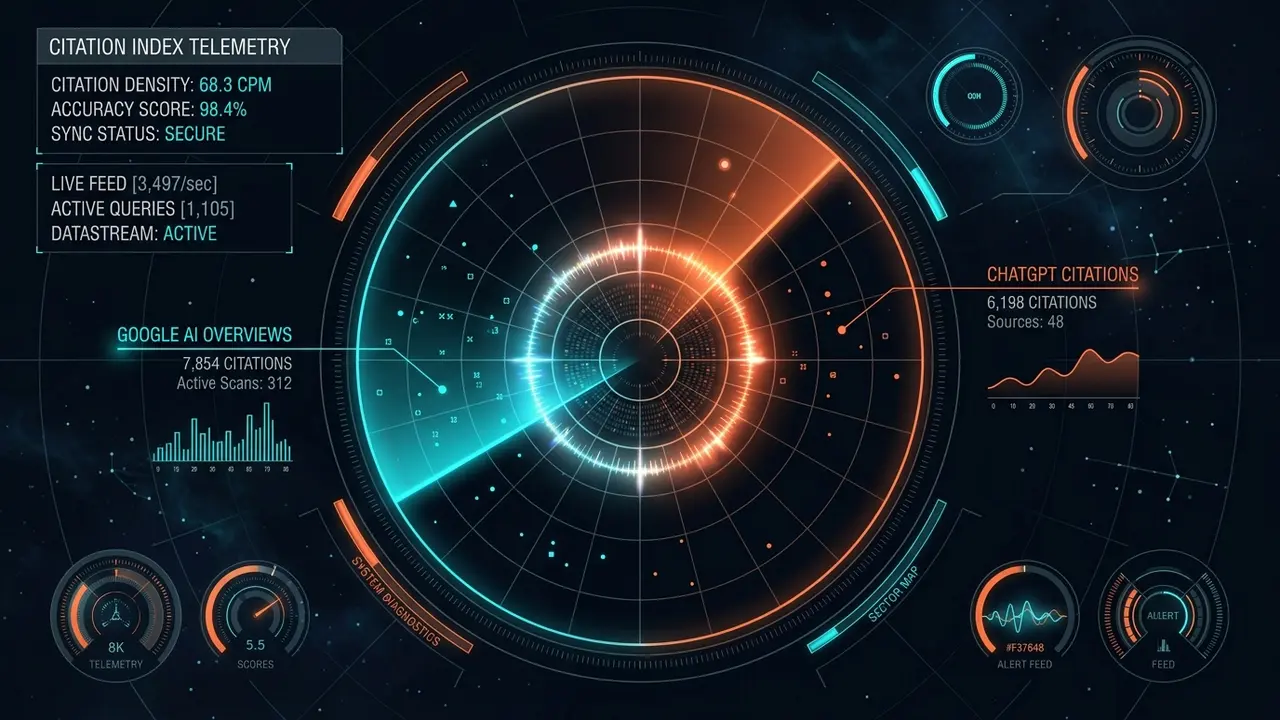
Standard rank checkers only record legacy DOM positions. BrandMeWeb Tracker deploys a specialized multi-engine parser that evaluates generative search results across three distinct vectors:
- 1**Generative Block Detection (
generative_search)**: Identifies whether Google has triggered an AI Overview for your target keyword in desktop and mobile environments. - 2Source Card Verification: Evaluates whether your domain appears in the horizontal source carousel, recording your exact citation index (#1, #2, or #3 source card).
- 3LLM Citation Probability: Models the semantic proximity between your content and the retrieval prompts utilized by Perplexity Sonar and OpenAI SearchGPT.
┌────────────────────────────────────────────────────────────────────────┐
│                     AI CITATION RETRIEVAL PIPELINE                     │
├──────────────────┬──────────────────┬─────────────────┬────────────────┤
│ 1. User Query    │ 2. Fan-Out Search│ 3. LLM Parsing  │ 4. Radar Tele. │
│ High-intent B2B  │ Sub-queries sent │ RAG evaluates   │ BrandMeWeb logs│
│ commercial prompt│ to live web index│ 40-word blocks  │ citation index │
└──────────────────┴──────────────────┴─────────────────┴────────────────┘
The 40-Word Declarative Answer Framework#
To earn direct citations in Google AI Overviews and ChatGPT Search, your website architecture must adapt to how Large Language Models perform Retrieval-Augmented Generation (RAG). AI models prioritize content that provides deterministic, high-entropy factual answers.
The 3 Core Rules for RAG Citation Domination:
- The 40-Word Atomic Definition: Immediately beneath every H2 and H3 heading, write a self-contained, declarative 40-word summary that directly answers the core question before elaborating on nuances.
- Structured Semantic HTML Tables: LLMs extract structured data from
<table>elements with 3.4x higher confidence than unstructured prose when synthesizing comparative recommendations. - Linked Entity Knowledge Graphs: Embed Schema.org
@graphstructures linking yourOrganization,Person(Founder), andProductentities with verifiedsameAsreferences.
<!-- Example: RAG-Optimized Declarative Answer Structure -->
<h2>How Does Next.js Edge SSR Improve AI Search Indexing?</h2>
<p>
  Next.js Edge SSR delivers pre-rendered HTML to search bots in under 50 milliseconds.
  By eliminating client-side JavaScript execution barriers, AI search crawlers (ChatGPT-User,
  PerplexityBot) ingest complete semantic content instantly on the first HTTP request.
</p>
Measuring the ROI: Traditional Search vs. Generative Engine Optimization#
Step-by-Step Playbook: Capturing AI Citations in 14 Days#
- 1Audit Your Current AI Citation Baseline: Input your top 10 commercial keywords into the BrandMeWeb Tracker. Check the AI citation indicator to identify which queries currently trigger generative blocks.
- 2Identify the #1 Cited Competitor: Use the Competitor Radar to extract the exact domain holding the primary source card in Google AI Overviews.
- 3Refactor Content with the 40-Word Rule: Update your target landing pages. Replace vague marketing fluff with precise, factual answers and structured comparison tables.
- 4Inject Linked Schema.org Knowledge Graphs: Deploy JSON-LD graphs establishing your verified brand authority and principal architect entity.
- 5Run Daily Verification Scans: Track your progress daily in the BrandMeWeb dashboard. As Google re-crawls your optimized SSR pages, watch your domain transition into the top source carousel.