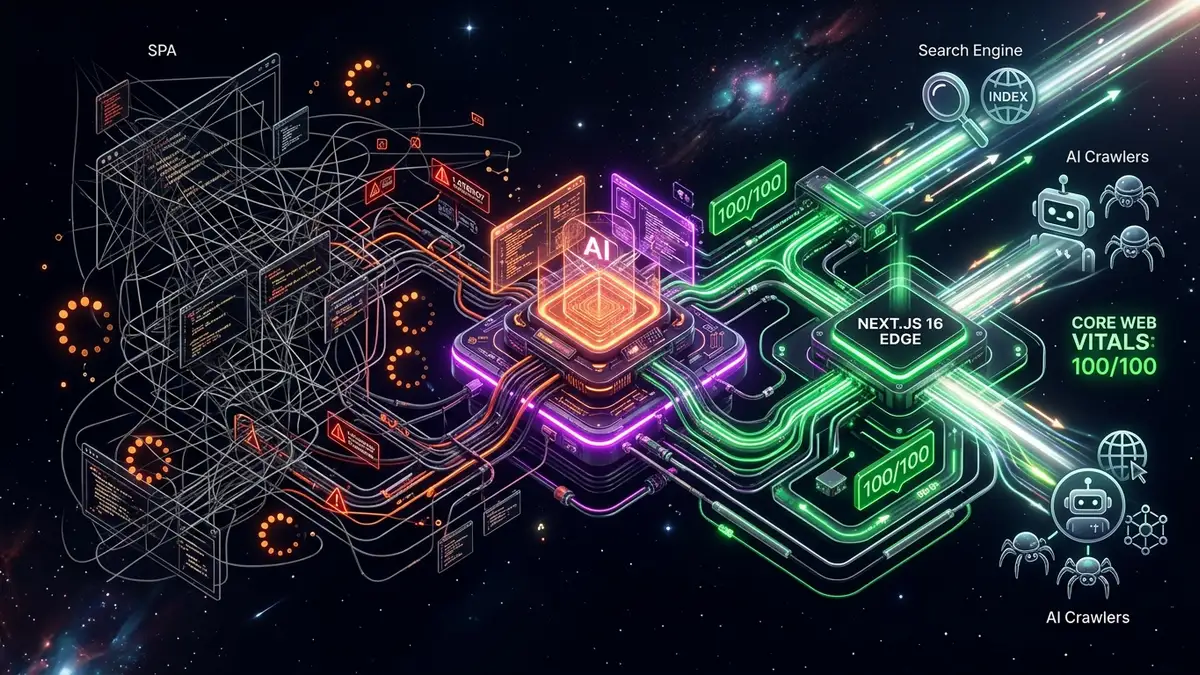
The 48-Hour MVP Euphoria vs. The Zero-Traffic Reality#
The generative AI coding revolution has fundamentally transformed early-stage software engineering. With platforms like Lovable, Bolt.new, Cursor, and v0, solo founders and technical teams can prompt full-stack prototypes into existence in 48 hours. Beautiful dashboards, interactive chat agents, authenticated user sessions, and Stripe billing workflows appear almost magically from natural language prompts.
Then comes launch day. The founder shares the URL on Twitter/X, LinkedIn, and Product Hunt, generating an initial 48-hour spike of curiosity traffic. But two weeks later, the reality sets in: 1. Google Search Console reports flatlined zero impressions. 2. Target commercial search queries—*'AI CRM for clinics'*, *'automated invoice reconciliation software'*, *'contract review copilot'*—yield zero organic rankings. 3. Generative AI answer engines (OpenAI ChatGPT Search, Perplexity Pro, Claude) fail to cite the product or recommend direct competitors instead. 4. Paid acquisition costs ($15 to $55 per click on Google Search Ads) rapidly drain seed capital with unsustainable customer acquisition costs (CAC).
What went wrong? The prototype fell into the Vibe Coding Single-Page Application (SPA) Trap.
While generative AI code assistants excel at generating functional client-side React code inside Vite or pure SPA containers, they default to an architectural pattern that is fundamentally hostile to search engines: pure Client-Side Rendering (CSR).
> An AI-generated MVP that delivers instantaneous client-side UI interactivity is commercially worthless if search crawlers and LLM indexing bots receive a blank HTML shell. In modern enterprise software, if your markup is not server-rendered at the edge, your product does not exist.
The Architectural Anatomy of Search Invisibility#
When Googlebot, Bingbot, or AI retrieval crawlers inspect a pure Lovable, Bolt, or Cursor prototype, they encounter a critical architectural disconnect:
┌────────────────────────────────────────────────────────────────────────┐
│            THE CLIENT-SIDE RENDERING (CSR) INDEXING BOTTLENECK         │
├──────────────────────────────────┬─────────────────────────────────────┤
│ What the Browser Sees (After JS) │ What Search Bots & AI Crawlers See  │
├──────────────────────────────────┼─────────────────────────────────────┤
│ • Rich interactive dashboard     │ • <!DOCTYPE html><html><head>...    │
│ • Dynamic product features & pricing • <div id="root"></div>           │
│ • Customer testimonials & FAQs   │ • <script src="/bundle.js"></script>│
│ • Client-hydrated interactive UI │ • ZERO text, ZERO headings, ZERO links│
└──────────────────────────────────┴─────────────────────────────────────┘
1. The Two-Wave Indexing Queue and Render Timeout Google operates a two-wave indexing system. In Wave 1, Googlebot fetches the raw HTML and indexes immediately available text. If the page is a CSR application containing only `<div id="root"></div>`, Googlebot indexes virtually nothing.
The URL is then relegated to the second-wave rendering queue (the Web Rendering Service or WRS), where Google's headless Chrome instances execute client JavaScript. In 2026, with billions of daily web pages competing for compute cycles: - Second-wave rendering is delayed by anywhere from 5 to 28 days. - If the AI-generated JavaScript bundle exceeds strict execution time limits (5 seconds) or hits unhandled runtime exceptions during hydration, rendering aborts silently. - Googlebot drops the page from the indexing pipeline, categorizing it in Search Console as *'Crawled - currently not indexed'* or *'Discovered - currently not indexed'*.
2. Generative AI Answer Crawlers Do Not Execute JavaScript The blindspot is even more catastrophic for generative AI search engines. Bots such as **ChatGPT-User**, **PerplexityBot**, **Claude-Web**, and **Google-Extended** crawl web pages at massive scale to feed Retrieval-Augmented Generation (RAG) pipelines.
Unlike Googlebot, AI crawlers do not maintain expensive headless Chrome rendering clusters. They perform lightning-fast HTTP GET requests and parse raw HTML text streams. When an AI crawler requests a Lovable or Bolt SPA, it receives zero semantic text. As a result, when an enterprise executive prompts ChatGPT: *'Recommend the top AI invoice automation tools in Israel'*, the AI cannot find your product in its ingested knowledge graph and recommends legacy competitors who deployed server-rendered HTML.
3. Core Web Vitals Collapse on Monolithic AI Bundles AI coding generators notoriously produce bloated, un-tree-shaken client bundles. A standard Lovable or Cursor prototype routinely downloads 2.5MB to 5MB of JavaScript on initial page load, importing complete component libraries (Radix UI, Lucide icons, Framer Motion, TanStack Table) into a single monolithic bundle.
The result is catastrophic Core Web Vitals (CWV) telemetry: - Interaction to Next Paint (INP): Exceeds 350ms – 550ms as the single main thread struggles to parse megabytes of script. - Largest Contentful Paint (LCP): Exceeds 4.5 seconds on mobile 4G/5G connections. - Cumulative Layout Shift (CLS): Uncontrolled layout jumping as client-side data fetches resolve asynchronously after initial paint.
Google's Core Web Vitals algorithm enforces strict ranking penalties on domains failing CWV thresholds, guaranteeing that the prototype remains buried past page five of search results.
The 4 Pillars of Lovable Code Rescue#
To rescue an AI-generated MVP and turn it into a high-converting, indexable SaaS engine, BrandMeWeb executes the Lovable Code Rescue architectural protocol:
┌────────────────────────────────────────────────────────────────────────┐
│             THE 4 PILLARS OF NEXT.JS 16 SSR CODE RESCUE                │
├──────────────────┬──────────────────┬─────────────────┬────────────────┤
│ 1. Edge SSR      │ 2. Zero-Bundle   │ 3. Linked Graph │ 4. ZTDS Privacy│
│ Sub-45ms TTFB    │ Decoupling UI    │ SoftwareApp &   │ Amendment 13 & │
│ Server-rendered  │ Server Components│ TechArticle     │ Zero Data Leak │
│ semantic HTML    │ zero client JS   │ Schema.org      │ Client Sandbox │
└──────────────────┴──────────────────┴─────────────────┴────────────────┘
Pillar 1: Edge Server-Side Rendering (SSR) & Sub-45ms TTFB We migrate the prototype from static client containers (Vite / CRA) to **Next.js 16 App Router** deployed across global Edge CDN nodes. Every route pre-renders semantic HTML on the server in under 45 milliseconds. When Googlebot or PerplexityBot requests any page, complete H1-H3 headings, marketing copy, feature specifications, and pricing tables are delivered in the initial HTTP response packet—zero JavaScript execution required.
Pillar 2: Zero-Bundle Shift (Decoupling Interactive UI from Semantic HTML) We re-architect the component hierarchy using React Server Components (RSC): - Marketing pages, documentation, feature overviews, and pricing calculators are rendered 100% on the server with **0KB of client JavaScript**. - Client-side interactivity (`'use client'`) is isolated strictly to atomic components that require browser state: authenticated billing modals, dynamic search filters, and interactive canvas elements. - Initial JavaScript payload drops from **3.8MB down to less than 120KB**, instantly elevating Core Web Vitals to a flawless 100/100 score across mobile and desktop.
Pillar 3: Dynamic Linked Schema.org Knowledge Graphs We inject structured JSON-LD schemas into server-rendered markup: - `@type: "SoftwareApplication"` declaring application category, operating systems, feature lists, and verified pricing offers. - `@type: "TechArticle"` establishing technical authority and architectural documentation. - `sameAs` URI links connecting the startup entity to GitHub repositories, founder LinkedIn profiles, and verified tech registries (Product Hunt, Crunchbase, Startup Nation Central). - Machine-readable knowledge corpuses (`/llms.txt` and `/llms-full.txt`) providing pre-parsed 40-word semantic entity definitions for AI search bots.
Pillar 4: Privacy & Amendment 13 Compliance (Zero Data Leak) AI startups processing customer prompts face severe legal liabilities under Israel's Privacy Protection Law ([Amendment 13](/en/services/ai-compliance-privacy-audit)) and GDPR. AI code generators frequently leak sensitive user inputs, API keys, or database credentials directly into client-side bundles. We implement the [Zero-DPA Compliance Architecture](/en/compliance/zero-dpa-memo), isolating all AI agent logic and secret keys behind authenticated server actions and client-side RAM sanitization.
Comparative Benchmark: Pure Lovable/Cursor SPA vs. BrandMeWeb Next.js 16 SSR#
Unit Economics: Why Organic Search Is Life-or-Death for AI Startups#
Consider the capitalization economics of a post-launch tech startup or bootstrapped SaaS:
- Paid Search Reality (Google Ads): In competitive software categories (*'AI CRM'*, *'legal tech automation'*, *'developer tools'*), cost-per-click (CPC) ranges between $15 and $45 (₪55 to ₪165 per visitor).
- Burn Rate at Scale: Generating 500 qualified visitors per month via Google Ads requires $7,500 to $22,500 / month (₪28,000 – ₪85,000/mo) in ad spend alone. If the app converts at 2%, customer acquisition cost (CAC) exceeds $1,000 per user.
- The Organic Next.js Advantage: Once migrated to Next.js 16 SSR with linked entity schemas, the startup captures high-intent organic search queries at zero incremental marginal cost.
Investing in our fixed-scope Lovable Code Rescue (₪4,900 to ₪12,000 fixed price) or our ongoing Enterprise Domination Retainer (₪9,900 / month) pays for itself within the first 60 days by permanently eliminating reliance on expensive paid search clicks.
4-Step Technical Migration Checklist for Tech Founders#
- 1Run the Search Visibility Diagnostic: Test your MVP domain in our Free Google Rank Checker and ChatGPT Brand Visibility Audit to determine whether search engines and LLMs can extract your core value proposition.
- 2Audit Raw HTML Output: Open your application URL in terminal using
curl -s https://yourdomain.com | grep -i "<div id". If the returned body is an empty root container with script tags, your application is completely invisible to AI search bots. - 3Isolate Server Components from Client Interactivity: Refactor public landing pages, pricing pages, and blog documentation into pure React Server Components, stripping unnecessary client state hooks (
useState,useEffect) from static text. - 4Deploy Edge SSR with Linked Data Schemas: Migrate to Next.js 16 App Router on edge infrastructure, inject dynamic
SoftwareApplicationJSON-LD, and publish/llms.txtknowledge files.
To have Principal Systems Architect Ilya Sibiryakov perform an end-to-end architectural migration with guaranteed 100/100 Core Web Vitals, explore our dedicated Lovable Code Rescue Service or contact our engineering desk directly.